Pierre and Yvonne give several demos you can see on our recorded video. Make sure you don’t miss Pierre giving a real-time demo of Jacques Bertin’s reorderable matrix!
Episode Chapters
00:00:00 Intro
00:01:08 Topic: Data Sculptures with Yvonne Jansen and Pierre Dragicevic
00:04:01 Studies on legibility of physical 3D data visualizations
00:12:45 Pros and cons of rapid prototyping vs. subsurface engraving
00:16:57 Broader perspective: How did Pierre and Yvonne get Pierre and Yvonne’s motivation, and general characterization of the field
00:22:04 Their project collections at: http://www.aviz.fr/Research/PassivePhysicalVisualizations and http://www.aviz.fr/Research/ActivePhysicalVisualizations
00:27:26 Bertin’s reorderable matrix
00:35:00 Slow data
00:37:30 Back to Bertin and physical manpulation of data
00:39:04 Social aspects
00:39:47 Future perspective
00:41:21 Digital fabrication techniques
00:49:45 Online services
00:50:27 FabLabs
00:54:17 Accessibility aspects
00:55:33 Practical applications
00:57:54 Shapeshifting displays and materials
01:05:46 Early examples and the great books from W. Brinton
We invited a few experts in a Google Hangout to discuss what was big in 2012 and what will happen in 2013. We have Andrew Vande Moere from Infosthetics, Andy Kirk from Visualisingdata and Bryan Connor from The Why Axis.
Chapters Breakdown:
00:00:00 Intro
00:01:22 Our guests: Andrew Vande Moere from http//infosthetics.com
00:02:07 Andy Kirk from visualisingdata.com
00:03:07 Bryan Connor from the Why Axis
00:03:51 What was big in 2012 and what is coming 2013
00:04:05 More education and training
00:05:05 Technical issues…
00:06:05 More general interest in learning data visualization
00:07:01 Mike Bostock and d3
00:07:55 Alberto Cairo’s online infographics course
00:09:06 Mike Bostock and d3 again 🙂
00:10:32 Integrated print <-> interactive workflows
00:11:28 Democratization
00:14:58 Academic trends?
00:15:40 Visualization as a tool for communication
00:21:02 The human touch
00:22:39 Storytelling: people are actually doing it now
00:25:10 Woops – there he goes…
00:25:28 Tools for storytelling
00:26:30 So-called “network problems”
00:27:07 Snow Fall by NYT
00:31:49 More tools for storytelling and the return of “multimedia”
00:33:03 More case studies and behind the scenes reports
00:35:11 Less blogging in 2012?
00:42:46 Santiago Ortiz — @moebio
00:43:41 emoto
00:44:58 Real-time data visualization
00:49:28 Reaching wider audiences
00:50:14 Conferences, marathons, competitions
00:54:22 Simon Scarr
00:55:15 Wishes for 2013
01:01:05 Guest wishes for 2013
We got Robert Kosara on Data Stories for this episode. Robert is the editor of eagereyes.org, one of the most respected and well-known data visualization blogs in the Internet. He is known for his controversial and informative posts and his “academic” style (some people say :)).
But Roberts, as he says in the show, wears many hats. He was a Professor of Computer Science at UNC Charlotte until recently when he surprisingly moved to Tableau after being tenured.
In the show we talk about his choice and many other things: viz research, blogging, Tableau, etc. See the episode breakdown below.
And, as usual, have fun!
Enrico & Moritz
—
00:00:00 Enrico and Moritz catching up
00:04:22 Today’s guest: Robert Kosara
00:05:23 eagereyes.org and blogging in general
00:08:14 Enrico’s blog
00:09:46 Robert’s research themes
00:11:35 Blur as a retinal variable?
00:13:13 Interdisciplinarity in infovis research
00:14:31 How Robert got started
00:19:04 Early years of eagereyes.org and abandoned plans for the site
00:21:59 “lines in the sand”
00:27:04 What will the future bring for eagereyes?
00:30:58 State of visualization blogging
00:33:16 Blogging and academic careers
00:36:17 Openness and sharing ideas
00:43:04 The real story! Robert’s move to Tableau
00:51:22 Researching: storytelling with data
00:55:40 Visualization in wider communication contexts and workflows
00:59:13 Tableau for Mac?
01:01:36 A few ideas for improvement
01:03:12 Clevelandgate
01:08:16 Future for word clouds as a final slide for powerpoint presentations?
01:10:14 Robert’s influences?
01:13:38 How much work was it to release Parallel Sets, and was it worth it?
01:16:13 Wrapping it up
We just finished recording the hangout. 10 people joined it and some more followed the stream off-line. If you wanted to participate and you could not — we are sorry but there is a limit of maximum 10 people imposed by Google.
We really enjoyed the hangout and it was a fantastic experiment full of interesting questions and comments.
Unfortunately, as with any experiment, something can go wrong and it went wrong: we totally screwed up the video part by having Benjamin Wiederkehr in focus all the time instead of switching between the participants. For this reason we turned down the video part and kept the audio. The gist is still there!
We would like to experiment with Google Hangout and create a Data Stories event where we can all get connected live on it. It’s an experiment, we don’t know if it will work but we think it’s worth a try.
You can ask the questions you always wanted to ask (we like the scary and irreverent ones of course) and we’ll get the opportunity to see some of your faces more closely!
The event will be held on Tue, Nov 13th at 2pm EST (8pm CET for most Europeans).
IMPORTANT: we want the get the feeling of how many people intend to participate. Please add a brief commet here below if you want to participate or drop us a line at mail@datastori.es.
In order to participate you have to make sure you have a working account on GH. Best, is to try out with some friends. We’ll post the link to join the hangout shortly before the event on the blog and twitter. For technical reasons we cannot post it beforehand.
We are super excited to try out this experiment. The whole hangout is automatically recorded and we’ll post it online.
Please don’t hesitate to ask questions. Stay tuned and be ready!!!
I managed to grab a couple of buddies at VisWeek and record a (low audio quality – sorry) episode with some on-the-spot comments. Andrew Vande Moere (infosthetics.com) and Jerome Cukier joined me to have some fun and indulge in some gossiping.
A few papers we mention in the episode (may be not complete):
Have fun! And hey … big big thank yous to all the data stories listeners who stopped me to say hi. I loved it!
-Enrico.
P.S. Moritz was not there and lots of people asked me about him. What can I do? Just let him know how much you want to see him (he will hate me for writing this ;))!
Hi, we have Alberto Cairo on the show for Episode #12! If you don’t know who Alberto is, well… it’s your fault! Check his web site first. He has a fantastic book out on Infographics and Visualization called “The Functional Art,” which can directly go in your shelf between the Tuftes and the Fews.
We talk about the book and many many other things. Alberto is so talkative and deep that we could have recorded for another 3 or 4 hours. Lots, lots of fun! We loved it.
—
Episode breakdown:
00:00:00 Data Stories Number Many
00:03:29 Special guest today: Alberto Cairo
00:05:30 Background: Journalism and Teaching
00:13:01 Book: The functional art
00:19:25 Low-tech visualization
00:23:38 Differences between data visualization and information graphics / data journalism
00:31:51 How to work under practical constraints in a newsroom
00:39:11 International news graphics scene
00:42:37 Experimentalism vs conservatism
00:46:52 Connect print and online
00:48:17 Flash! (ah, the good times)
00:49:40 Back to “The Functional Art”
00:53:21 The visualization wheel
00:57:59 Use of multiple representations
01:04:02 Power of annotations
01:05:44 Wrapping it up
In this episode we talk about emoto, the project on visualizing the sentiment of the Olympic Games in London 2012.
Since Moritz was one of the principal designers and developers behind the project, we thought: “hey, why not?!”
And we have a special guest! Stephan Thiel from Studio NAND joined us to share his own view and experience with the project.
Make sure to give a look to the emoto web site and the accompanying blog before listening to the podcast if you can, this will help you following our discussion … just in case you are not familiar with the project yet … just in case.
00:00:00 Intro – catching up
00:04:44 emoto – with our special guest Stephan Thiel from Studio NAND
00:06:58 How it all started
00:09:32 The team
00:13:19 Live sentiment visualization
00:17:44 How to test a real-time system for a one-off event?
00:21:09 The processing timeline
00:24:56 Sentiment analysis
00:27:06 Topic detection – supervised vs. unsupervised
00:28:17 The other project parts – data blog and data sculpture
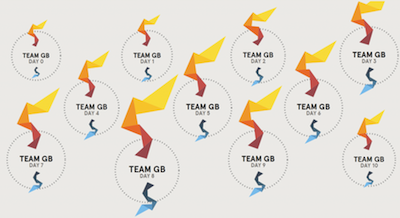
00:31:00 Origami visualization
00:38:10 Color scale
00:42:34 Message stream view
00:49:00 “Sentigraphs”
00:54:47 Data sculpture
01:00:30 What’s next
It’s been a long time since our last episode. Sorry, sorry, sorry! Moritz was/is busy with Emoto and the London Olympics, Enrico is moving (with the whole family) to New York City.
In this episode we talk about bridging academia and industry. We touched upon this issue many times in the past so we decided to record a whole a special issue on that.
To help us with it we invited Danyel Fisher, a renown Information Visualization researcher from Microsoft Research. This year Danyel is chairing the newly established Industry Track at VisWeek 2012, the leading conference in Visualization, and his job is to attract more people from industry to this traditionally pretty academic conference.
We discuss existing practices, gaps, and ways to bridge them. Here is the breakdown of the episode:
[00:00:00] Our special guest today: Danyel Fisher
[00:04:00] Relations between research and project departments at Microsoft
[00:12:39] Existing gaps between between research and practitioners
[00:16:09] Transfer of algorithms, e.g. Voronoi treemaps
[00:18:40] Visweek industry track
[00:32:03] Affordability of big conferences for individuals, lowering the threshold
[00:38:20] Live transmission from visweek?
[00:39:21] How can non-academic conferences attract more researchers?
[00:43:09] Researchers and their presence on the web
[00:50:30] Are papers an adequate publication format for visualization research?
[00:52:39] What else can we do?
[00:54:27] How to get designers to read papers
[00:59:28] Text books: Colin Ware, Tufte, Beautiful Visualization
[01:05:52] Danyel’s current research: Interaction with Big Data
[01:12:12] Final pleading for visweek and potentially exciting encounters with Moritz in an elevator